The unprecedented conflict and exchange of fire between Israel and Iran which began last Thursday (12.6.2025) signals the ultimate manifestation of deep and prolonged historical and ideological processes that characterize the Iranian curriculum.
From an historical perspective, Iran’s nuclear ambitions trace back to the 1950s, during the reign of Shah Mohammad Reza Pahlavi. With the support of the United States through President Dwight D. Eisenhower’s “Atoms for Peace” initiative, Iran began developing its nuclear infrastructure allegedly as a peaceful civilian program. Iran became a signatory to the Nuclear Non-Proliferation Treaty (NPT) in 1968 and ratified it in 1970, thereby agreeing not to pursue nuclear weapons and to allow inspections of its nuclear facilities by the International Atomic Energy Agency (IAEA). The 1979 Islamic Revolution, which toppled the monarchy and brought a theocratic regime to power, was initially skeptical of nuclear technology, associating it with Western influence, and initially suspended many nuclear projects, focusing instead on missile technology. However, the devastating results of the Iran-Iraq war, in which Saddam Hussein reportedly fired chemical weapons against the Iranian people, reignited the Iranian regime’s interest in nuclear technology as a strategic asset. Support from countries such as Pakistan, China, and later Russia helped Iran revive its nuclear program, and by the early 2000s Western intelligence agencies began suspecting Iran of concealing efforts to develop nuclear weapons under the guise of a civilian energy initiative.[1]
The failure of the latest round of negotiations between Iran and the U.S, preceded by the withdrawal of the U.S. from the Joint Comprehensive Plan of Action (JCPOA) agreement signed in 2015, have pitted Iran and Israel more closely against one another. To this point, Tehran refuses to halt its enrichment and continues its attacks on Israeli military and civilian targets alike, while Israel aims at destroying Iran’s nuclear capabilities.
In this dramatic context, it is important to address how Iran’s commitment to war with Israel, the U.S., and indeed the broader West, promulgating a global revolution, emanates from a particular radical Islamist ideology – Khomeinism, introduced by the leader of the Islamic Revolution Imam Ruhullah Khomeini. Key to this ideology, and drawing on Twelver Shii messianic theology and political theory, the Imam or its jurist representatives (i.e. the Ayatollahs) are political leaders ordained and tasked to promulgate Shii Islam not only in the Muslim world but to the entire world, by any means necessary. In Khomeini’s own words, quoted in the Iranian curriculum, “Our war is a war of conviction, and it does not know geography or borders. And in our war of faith, we must launch a major mobilization of Islamic troops in the world.”[2] Importantly, Iran has impressed this ideology into its education system. School textbooks and curricula are widely recognized as strong political indicators because they often reflect the prevailing ideologies, values, and political agendas of those in power at the time of their creation or revision.[3] To better understand Iran’s entrenched stance, and how it maintains this stance while facing international sanctions coupled with economic and political instability, it is thus vital to expound how Iran inculcates its students on global war, the West, foreign influence, its position in the Middle East, uncompromising militia doctrine, and its nuclear vision.
Inculcating the Khomeinist Revolution and Demonization of the West
Maintaining the legitimacy of the Islamic Khomeinist vision requires constant affirmation and veneration of the regime’s symbols and simultaneously vilifying its enemies. Indeed, this is a common facet of Shii Islam, which throughout history instituted in its believers the dualistic concept and practices of walāya and barā’a – i.e., absolute veneration of the Shii Imams and dissociation from their enemies through defamation, vilification, and cursing rituals.[4] Iran’s role in promoting the global Khomeinist revolution occupies a significant place in state issued textbooks. Utilizing a discourse reminiscent of the cult of saints, students are taught to venerate its religious political leaders Imam Khomeini most of all, and to some lesser degree the Supreme Leader Ayatollah Khamenei.[5] Moreover, the glorification of jihad against the West and martyrdom is promulgated through graphic portrayals of infamous military and terrorist figures who died promoting the values of the Khomeinist revolution, chiefly General Qasem Soleimani.[6] The glorification of Qasem Soleimani, which occurs across multiple school grades and subjects, is particularly telling of Iran’s dedication towards inculcating its future generations in aggressive anti-Western warfare as a key element of the Islamic revolution. Soleimani symbolized the peak of Iran’s militia doctrine, and textbooks glorify his heroic role in Iran’s proxy wars defending Islam. His leadership in regional conflicts is portrayed as beneficial, promising strategic gains for Iran and its allies. Iranian militias across Lebanon, Syria, Iraq, and Yemen have been depicted as a unified resistance front, an essential pillar of Iranian interests.[7] Such depiction may prompt students to accept ongoing regional conflicts as legitimate and absolutely necessary.
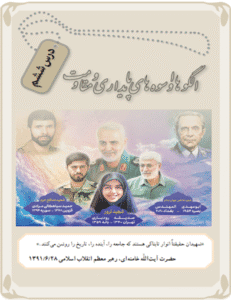
LESSON 6: Patterns and Role Models of Steadfastness and Resistance
“Martyrs are bright lights that illuminate society, the future, and history” Ayatollah Khamenei, Supreme Leader, September 18, 2012
Defense Readiness, Grade 10, 2024-25 (1403), p. 45.
A noticeable innovation of Khomeinist education, as compared to more traditional forms of Shiism, is the shift in hate from a focus on Sunnis towards what is often described as the Imperialist West. Beyond geopolitical considerations, the curriculum inculcates total aversion to Western values, such as secularism and non-Islamic family and sexual norms. The Iranian curriculum teaches students that they are constantly under threat, most notably from the United States. Students are taught that the foreign threat of the West, chiefly the United States, seeks to prevent Iran from spreading Islamic culture worldwide and brainwash the Iranian people. There is a notable thread in Iranian textbooks that instils in students a sense of paranoia when it comes to “foreigners.” Furthermore, the dedication to Khomeinist Iran is taught as a benchmark to determine who is and who is not a legitimate Muslim. Students learn that Muslims who do not follow the anti-foreigner policies of Iran should not be considered Muslims.[8]
Said to strengthen unity and resistance against the enemies of Iran, textbooks describe annual school protests such as the “National Day of Fighting Arrogance (America)” as having students involved in ritually shouting slogans like “Death to Israel” and “Death to America”.[9] American leaders are routinely vilified, and the United States is characterized as the Satanic enemy of God and of the Prophets, whose primary aim is to destroy Iran through conducting proxy wars across the region.[10] Notably, pre-revolutionary American-Iranian relations are described in a skewed manner, with the American and British ambassadors depicted as having fully controlled Iran during that period, with the US embassy hostages presented as spies.[11]
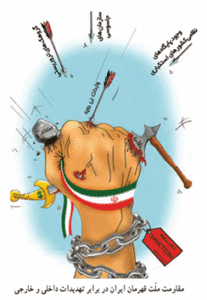
[Text under illustration] The National Heroic Resistance of Iran against Internal and Foreign Threats
[Illustration caption. The slings and arrows read:] Terrorist groups, spy organizations, arrogant countries’ bases, improper imports, hoarding, brokerage, and sanctions [in red, attached to chains.]
Defense Readiness, Grade 9, 2024-25 (1403), p. 17.
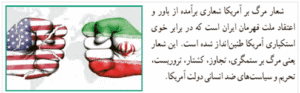
The slogan of “Death to America” emanates from the faith and the belief of the heroic nation of Iran that has become a resounding voice against American arrogant disposition. This slogan means death to tyranny, aggression, slaughter, terrorism, sanctions, and antihuman policies of the American government.
Defense Readiness, Grade 9, 2024-25 (1403), p. 31.
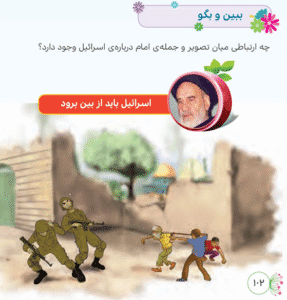
Look and Say
What is the relation between the image and the Imam’s statement about Israel?
[Khomeini:] “Israel must be wiped out!”
Heaven’s Presents, Grade 5, 2023-24 (1403), p. 102.
Iran’s Position in the Arab Middle East and the Promotion of Militia Doctrine
Iran’s perceived role in repelling Western aggression is also evident in how its curriculum legitimizes militia doctrine in the Arab Middle East. As part of the wider aim to export Iran’s envisaged revolutionary war across the region, students learn that Iranians should support the jihad of Arab proxy militias in the pursuit of fomenting regional instability. To advance this strategy, Arabic is taught as a pragmatic tool for preparing Iranian students for jihad operations.[12] The curriculum presents Iran as playing a pivotal role in defending the Southwest Asia region, which has endured numerous wars and assaults. It is presented as an inspirational model for the region’s populations to revolt against what are described as their “oppressive” regimes. Iran is also portrayed as a leading advocate for the oppressed, with particular emphasis on its support for the Palestinians. According to the educational narrative, Iran derives its strength from its strategic geography, substantial population, geopolitical significance, abundant oil and gas resources, and advancements in military science and technology—all of which are channelled into destabilizing neighboring countries.[13]
Notably, the Sunni Arab majority in the Arab world is depicted through a dual lens. On one hand, they are seen as fellow Muslims and oppressed communities who benefit from Iranian support and are engaged in Iran’s ongoing jihadist struggle. On the other hand, historical grievances linger—particularly memories of Arab conquerors and Sunni dynasties that subjugated Iranians and Shiites. Those Sunni actors who reject Iranian dominance, normalize relations with Israel, or maintain strong ties with the United States or the West are often portrayed as collaborators and traitors.[14] Students are also encouraged to partner with radical Sunni groups such as the Muslim Brotherhood, which is praised as being “the most original intellectual movement in the Islamic Awakening [the Arab Spring, for Iranians] of the Sunnis”. This cooperation is framed as a Sunni and Shii contribution to the “Islamic Awakening” (civil protest movements and civil wars in the Arab world).[15] Nonetheless, the curriculum warns against radical Salafi-Jihadi and takfiri groups and ideologies such as ISIS, which are explicitly and systematically presented as having been formed by “colonialist countries”, especially the U.S. and Saudi Arabia.[16]
To further promote the Khomeinist ideology, the curriculum militarizes youth and conditions students as soldiers in a global battle to expand the Islamic Revolution. Defense Readiness textbooks for high school teach military concepts and wartime survival. Students learn weapon handling and military readiness by middle school, reflecting a warrior mentality aimed at controlling the Middle East. As these textbooks depict political opponents as “enemies of God,” they teach the Iranian youth not just whom to hate, but how to fight, and that dying in the process, even by suicide, is a blissful experience. Among these depictions, we find inspirational portrayals of child warriors who had been martyred in service of the Islamic Revolution, particularly during the Iran-Iraq war.[17] Alarmingly, Iranian textbooks sanitize suicide martyr missions by distinguishing them from ordinary suicide, as one Grade 12 Sociology textbook ranks “martyrdom seeking” the most noble above “sacrificing one’s life” and “suicide”,[18] and the grade 9 Defense Readiness textbook teaches that martyrdom seeking is the most powerful asset against the enemy.[19]
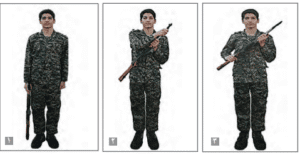
Illustrations of how to wield an AK-47 rifle.
Defense Readiness, Grade 10, 2024-25 (1403), p. 70.
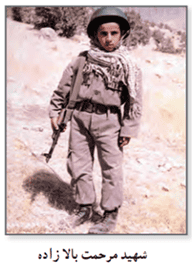
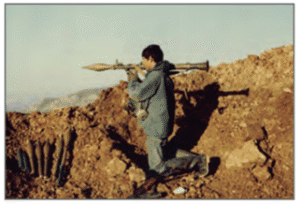
The martyr Marhamat Balazadeh,
Defense Readiness, Grade 10, 2024-25 (1403), pp. 37, 46.
Nuclear Vision
Importantly, how Iran perceives its nuclear project is crucial for evaluating its importance in the negotiation talks. The general tone of the curriculum – as seen in developing its nuclear facilities – is one of self-reliance and defying the revolution’s enemies.[20] The curriculum expresses strong national pride in Iran’s “nuclear achievements” and highlights the contributions of its young scientists. While the emphasis is placed on the peaceful use of nuclear energy, the narrative is infused with a revolutionary tone—framing progress as the result of overcoming formidable challenges posed by adversaries and honoring the sacrifices of martyrs. Mastery over the nuclear fuel cycle is presented as a hallmark of Iran’s status as a leading nation. The nuclear program’s military dimension is conveyed through its integration into the Defense Readiness curriculum. Nuclear scientists are portrayed as martyrs, alongside missile engineers and Iranian soldiers who died during military operations in the Arab world—framing their contributions within a broader narrative of national defense and sacrifice. Notably, the textbooks attribute the assassination of Iran’s nuclear scientists not only to Israel but explicitly to the United States, thereby reinforcing anti-American sentiment as a major theme. Conversely, a Qur’an Learning textbook frames the nuclear project as part of Iran’s cultural heritage;[21] by presenting the nuclear issue in a religious studies context, the regime effectively grants the nuclear project theological justification.
Research and present your findings in class about the heroes of the contemporary era, martyrs such as Mohsen Fakhrizadeh, Mostafa Ahmadi Roshan (nuclear scientists), Hassan Tehrani Moghadam (missile industry scientist) and Mohsen Hojaji (defender of the Haram). […]
Defense Readiness, Grade 9, 2024-25 (1403), p. 64.
Implications for Future Negotiations
With the flames of war seemingly intensifying, it is important to cast a light on education, understanding that curricula are instruments of state ideology. Far from merely educating the next generation, state textbooks embed the ideological worldview of governments and regimes. The portrayal of the “other” in textbooks reflects political strategy, in that the way textbooks depict external actors offers a unique lens into how the regime defines friends versus enemies. Textbooks therefore become part of the ideological battleground, when children deserve a less biased understanding of the world.
IMPACT-se’s reports clearly demonstrate how Iran’s textbooks reflect and promote the regime’s geopolitical stance, normalizing militarization, violent martyrdom, and anti-Western sentiment. The curriculum reinforces Iran’s revolutionary and expansionist ideology, ensuring that future generations will embrace these extremist goals. This may influence society, priming a generation for confrontation rather than negotiation. Militia activities are embedded in ideological teachings rather than tactical considerations, promising rewards like oil control, trade routes, regional dominance and nuclear self-reliance. Iran’s education system cultivates a “siege mentality”, creating an “us versus them” polarized narrative. This mindset makes compromise and diplomacy more difficult, as accommodation is framed as a betrayal of Iranian principles shapes a generation aligned with the regime’s aggressive vision.
Iran’s textbooks are being used as tools to perpetuate the normalization of militarization and martyrdom. They underscore a long-term commitment to conflict and ideological extremism, preparing Iranian youth to perpetuate the regime’s confrontational trajectory for multiple generations—or until reform is conducted. This reflects the regime’s long-term preparation and intention for continued conflict, which tallies with the lack of progress in nuclear talks.
The absolutist and indispensable value the Iranian textbooks ascribe to the nuclear program, showcasing them as a national right and duty, also indicates why negotiations have and will remain challenging, in the event that they are held following the current conflict.
Understanding that a change in mentality is crucially vital for future relations with the current Iranian regime, any post-conflict negotiations should look to include educational reform as part of human rights or social reform packages. Efforts to introduce human-rights clauses in nuclear negotiations, addressing martyr propaganda or child-soldier recruitment, might be viewed by Iran as attacks on the core principles of its revolution. Sanctions relief should therefore be directly linked to educational reform, emphasizing the urgency of upholding the Iranian curriculum to UNESCO standards of peace and tolerance in education, and refusal to compromise on the inculcation of children to become child soldiers. Once the flames of war are doused, educational reforms should be used as an indirect but critical measure to de-escalate and deradicalize Iranian views of the “other” and the West, primarily the U.S., and provide an opportunity for Iranian children to learn about an alternative future.
Please click here to read IMPACT-se’s most recent report on Iran’s curriculum
[1] Sina Azodi, “A history of continuity in Iran’s long nuclear program,” Atlantic Council, Dec. 8, 2020.
[2] Religion and Life 3, Grade 12, Literature and Humanities, 2024-25 (1403), p. 167; Cf. Eldad J. Pardo, “Iran’s Radical Education: An Interim Update Report, 2021-22,” IMPACT-se, August 2022, p. 17.
[3] See for instance Sam Kaplan, The Pedagogical State: Education and the Politics of National Culture in Post-1980 Turkey, California: Stanford University Press, 2006; Tobias Ide, Denise Bentrovato, Jakob Kirchheimer, “School Textbooks, Peace and Conflict: an Introduction,” Global Change, Peace & Security 30(3) (2018), pp. 287-294.
[4] See Meir Litvak, Know Thy Enemy: Evolving Attitudes towards “Others” in Modern Shiʿi Thought and Practice, Leiden; Boston: Brill, 2021; Yonatan Negev, “Cursing the Companions of the Prophet Muḥammad (la‘n al-ṣaḥāba) in Pre-Modern Twelver Shi‘i Religious Thought” (Doctoral Dissertation), Hebrew University of Jerusalem, 2022.
[5] Pardo, “Iran’s Radical Education,” pp. 7-9.
[6] Ibid, p. 71. Defense Readiness, Grade 9, 2024-25 (1403), pp. 30, 65; Social Studies (Civics, History, Geography), Grade 8, 2024-25 (1403), p. 129; Defense Readiness, Grade 10, 2024-25 (1403), p. 50; Arabic, Quran Language, Grade 9, 2024-25 (1403), pp. 127‒28.
[7] Ibid. “Iran’s Radical Education,” pp. 74-76, 85, 87.
[8] Ibid. “Iran’s Radical Education”, pp. 14-15, 18-20.
[9] Heaven’s Presents: Islamic Education, Grade 6, 2024-25 (1403), p. 33; Defense Readiness, Grade 9, 2024-25 (1403), p. 31; Heaven’s Messages, Grade 7, 2024-25 (1403), pp. 130-132.
[10] Defense Readiness, Grade 9, 2024-25 (1403), p. 30.
[11] Pardo, “Iran’s Radical Education”, pp. 11-12.
[12] Ibid., pp. 77-88.
[13] Ibid., p. 56.
[14] Ibid., p. 54.
[15] Ibid., pp. 62-63.
[16] Defense Readiness, Grade 10, 2024-25 (1403), p. 49.
[17] Pardo, “Iran’s Radical Education”, p. 46.
[18] Sociology 3, Grade 12, Literature and Humanities, 2024-25 (1403), p. 46.
[19] Defense Readiness, Grade 9, 2024-25 (1403), p. 36.
[20] Pardo, “Iran’s Radical Education”, p. 115.
[21] Qur’an Learning, Grade 6, 2024-25 (1403), p. 64.
[/av_textblock]