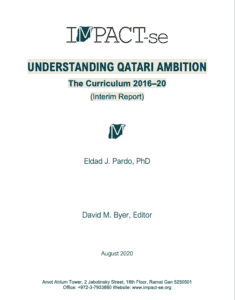
This IMPACT-se report continues to focus on Qatar’s school curriculum for grades 1–12. It has been updated in conjunction with the London-based think tank, Henry Jackson Society and a foreword by Dr. David Roberts of King’s College London. The study assesses over 314 textbooks, building upon previous IMPACT-se research within the prism of UNESCO standards and other UN and international declarations, recommendations and documents on education for peace and tolerance. Our review determined that the Qatari curriculum does not yet meet those international standards. As highlighted in the foreword, the curriculum reflects in many ways, the same overall tension facing Qatar’s leadership—between Qatar’s Islamist affinities and its desire to be seen as an open, neutral and progressive leader in the Arabian Gulf. Textbooks teach Qatari children to accept others different than themselves and advocate for peace—at the same time echoing antisemitic canards and reinforcing the Qatari regime’s support for Islamist terror organizations. While the curriculum emphasizes nationalist identities over tribal affiliations, it is also influenced by pan-Islamic and pan-Arab nationalism as well as elements of Salafism and the Muslim Brotherhood. Despite a slight movement away from radical jihadism, much remains. Nevertheless, Qatar’s curriculum remains heavily influenced by Western educators—displaying the Qatari gift for embracing contradictions.